


RIYADH: Not every difference needs to be fixed, some just need the rest of us to pick up a book and learn something about them.
Saad Al-Munajem, 26, the founder of stutter support nonprofit Mutalaathem, spoke to Arab News about how his personal experiences encouraged him to create the community.
Founded in 2021, Mutalaathem aims to empower people who stutter by allowing them to speak without letting it hold them back, while also working to change society’s misconceptions.
Stuttering is defined by the American Speech-Language-Hearing Association as a neurodevelopmental speech disorder characterized by involuntary disruptions in the flow of speech.
“A lot of people view it as a problem because you’re not speaking fluently like everybody else, but in reality it’s not a problem. It’s a different way of speaking,” Al-Munajem told Arab News.
He said that stuttering is neurophysiological, meaning it originates in the brain and cannot simply be “fixed” with medication or other quick solutions.
Because of that, he believes, the goal should be to understand and accept the disorder, not try to eliminate it.
Al-Munajem frames the difference very simply: the only real distinction between someone who stutters and someone who speaks fluently is time.
What he ultimately asks from society is straightforward: patience and attention.
“I want people to listen to what we say rather than how we say it.”
Throughout the various phases of his life, Al-Munajem was exposed to many experiences because of his stutter, some which helped and some which did the opposite.
His first memory of stuttering was when he was seven years old, in first grade.
A teacher asked him to read aloud in front of the class and when he stood ready to go — no words came out, only sounds. His classmates laughed at him.
“I didn’t know why they were laughing, but I knew it was at me, not with me.

“I wasn’t trying to make them laugh. I was just trying to speak.”
Al-Munajem described feeling a mix of anger, confusion and betrayal. The emotional impact of that moment was intense, and it left a lasting imprint on how he approached speaking.
Throughout his childhood, he attended several speech therapy clinics because his parents wanted to help him in the best way they knew how.
The therapy focused heavily on fluency techniques, and while these worked in clinical settings, they did not translate to real-life situations.
“They made it very obvious that I speak differently … it made me feel weird.”
Because of that discomfort, he gradually stopped using the techniques altogether.
“I would rather just try to hide my stutter.”

This pattern continued throughout high school and into the early days of university before Al-Munajem decided to seek other forms of help.
One day, strolling through the University of Washington campus, he spotted a speech therapy clinic and decided to go in.
His experience there was entirely different: instead of being told what to do, he was given space to explore his stutter and his feelings about it.
Even when introducing techniques, the clinicians emphasized choice and experimentation.
“They told me: we’ll show you everything, and then you can choose what works for you.”
This approach made the process feel engaging rather than restrictive.
“I started seeing it like a game almost,” Al-Munajem said.

One practical tool he adopted was pausing during moments of severe stuttering.
“If I feel stuck, I stop, release air, breathe, and then continue speaking.”
Importantly, this was presented as an optional tool — available if he needed it.
During this time, he became more aware of how stuttering had shaped his behavior. He realized that fear had prevented him from participating in class even when he knew the answers.
He also recognized how much of his discomfort came from overanalyzing others’ reactions.
“I used to hyper-analyze every facial movement … thinking they’re uncomfortable or confused.”
The biggest realization, however, was redefining success.

“Success to me doesn’t mean speaking fluently. It means: did I get my message across?
“My goal is not to speak fluent. My goal is to speak when I want to speak.”
Disclosure — openly telling people that he stutters — also led to a major shift in perception, both of himself and from others.
At first it felt counterintuitive, like the opposite of what he thought he was “supposed” to do.
But over time, telling people about his stutter actually reduced his anxiety and overthinking.
“When they know, I don’t get in my head anymore. I don’t start thinking: are they uncomfortable? Are they confused?”
He gradually taught himself to speak in increasingly difficult situations — from phone calls to ordering at restaurants and speaking to cashiers, to standing on street corners and initiating conversations with strangers — all leading up to the big moment.
Before one of his political science lectures, Al-Munajem had decided to raise his hand when the professor asked a question.
First step: confidence, second step: disclosure.
“I told him in front of everyone: I have a stutter, and I need more time.”
The response was supportive: “Take all the time you need,” the professor said.
He answered the question, and that was it — nothing happened.
“No one laughed. No one interrupted. They just listened.
“After that, my life changed 180 degrees.”
Al-Munajem thought he was just a naturally introverted person. After improving his communication skills, it turned out that he was just afraid, and that engaging with others socially was something he really enjoyed.
Once he returned home to Saudi Arabia, he noticed that the dominant approach still focused heavily on fluency — an approach he had found mentally draining.
“Your internal voice is then focused on how to say it, not what you want to say. (So), every time a stutter comes out, it feels like a failure.”
And if the suggested technique does not work, people blame themselves — not the technique.
Al-Munajem set out to challenge this model.
Looking back on his school days, he believes his teachers generally had good intentions but lacked understanding.
Some would call on him to speak less, others would complete his sentences.
“They thought they were helping,” but what he really needed was encouragement.
In everyday life, people would laugh out of their own discomfort or try to give unsolicited advice on how to “fix” the stutter.
Al-Munajem acknowledges that it almost none of it came from malice, but more out of ignorance.
This is why he sees organizations like Mutalaathem as essential.
The work they do is diverse; one example is regular support groups —online and in-person.
For someone with a stutter, he said, “one of the biggest feelings is loneliness … you feel like you’re the only one.”
These groups create connection and understanding — knowing you are surrounded by people who know how you feel before you even speak.
Another benefit is realizing that not everyone’s stutter looks or sounds the same, everyone’s experience is unique yet familiar.
The groups meet physically in Riyadh and Jeddah, but the online support groups have grown to encompass people from all over the Arab world.
“I never imagined I’d reach people from Lebanon, Syria, Kuwait …”
He also holds sessions in schools for students and teachers, and he even returned to his own school — King Faisal School — for a presentation that was especially meaningful.
“It felt like I was speaking on behalf of my younger self.”
One student even came up to him afterwards and asked to present with him next time.
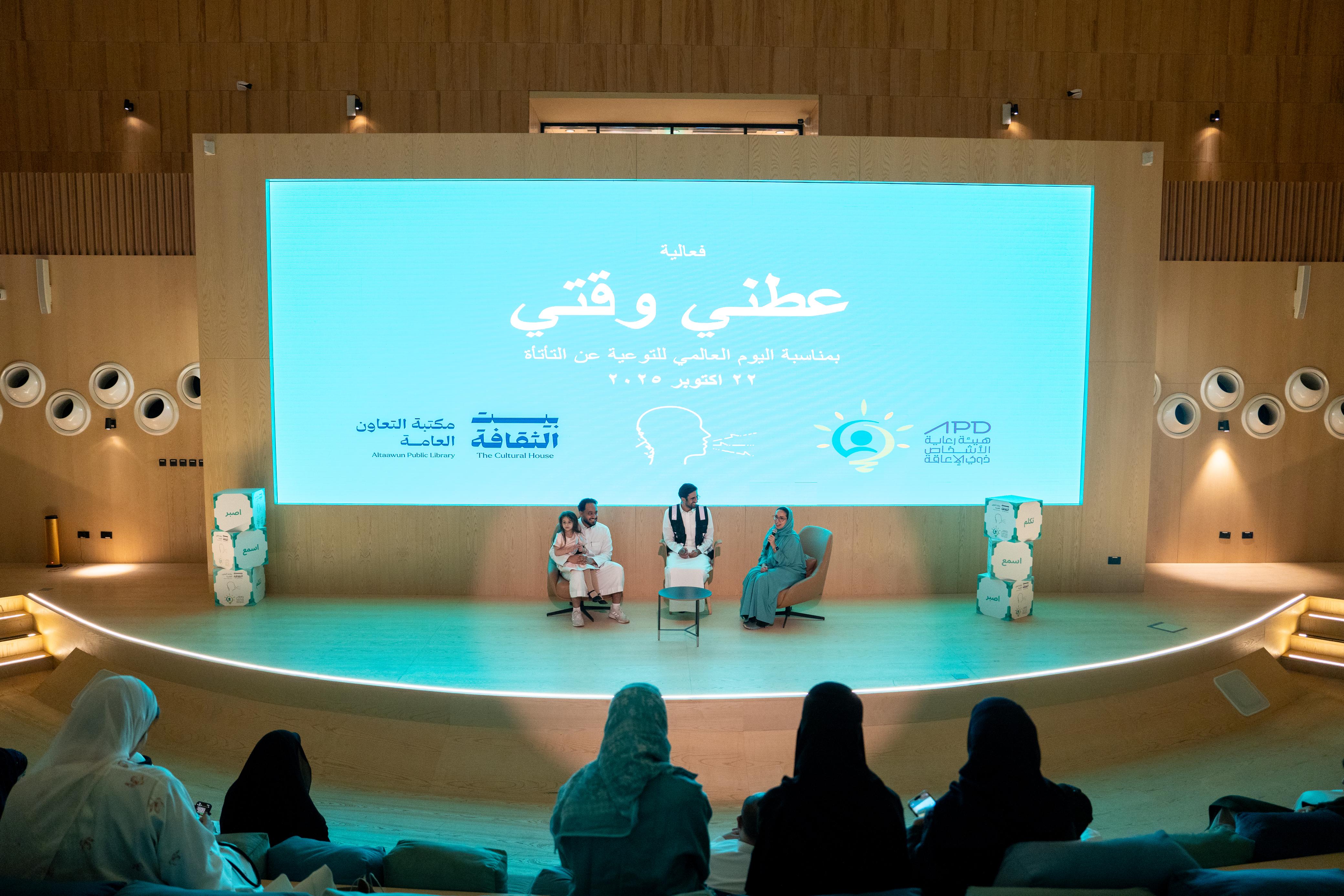
Al-Munajem has also given talks at various events, such as the International Stuttering Day’s “Etny waqty (Give me my time)” event, talking about stuttering as a hidden disability — a term he was initially uncomfortable with but has since appreciated the rights and protection that come with it.
His next big project is the first edition of Camp Dream. Speak. Live. — a collaboration with speech therapists at the University of Texas, Austin.
The camp will teach participants how to be effective communicators even with a stutter, with a focus on building confidence and resilience.
It is scheduled to be held from June 27 to July 1 for children aged 8 to 17.
Al-Munajem’s ambition is to shift the system toward more flexible, person-centered care.
He is also working on creative initiatives to raise awareness, including a photography project titled “Faces of Stuttering.”
“As I’m traveling around the world and meeting people who stutter, I take pictures of them and ask them — in one word — what does your stutter mean to you?”
An inspiration for him is Alda Villiljos, an Icelandic photographer who, in 2016, captured people in the actual moment of stuttering — making visible what is usually hidden or stigmatized.
While working on his project, Al-Munajem realized that only a small number of people chose words with negative connotations, while the majority were either positive or neutral.
Through TikTok and Instagram, he has gained a wide audience of people who stutter and those who want to learn more about it.
Currently, the organization is largely self-funded and Al-Munajem is working to formalize it to enable broader funding and donations.
“I’m trying to change the whole ecosystem.”
Al-Munajem’s final message to the public is simple: give us time to speak, and you’ll hear that we’re actually not that different.”


