
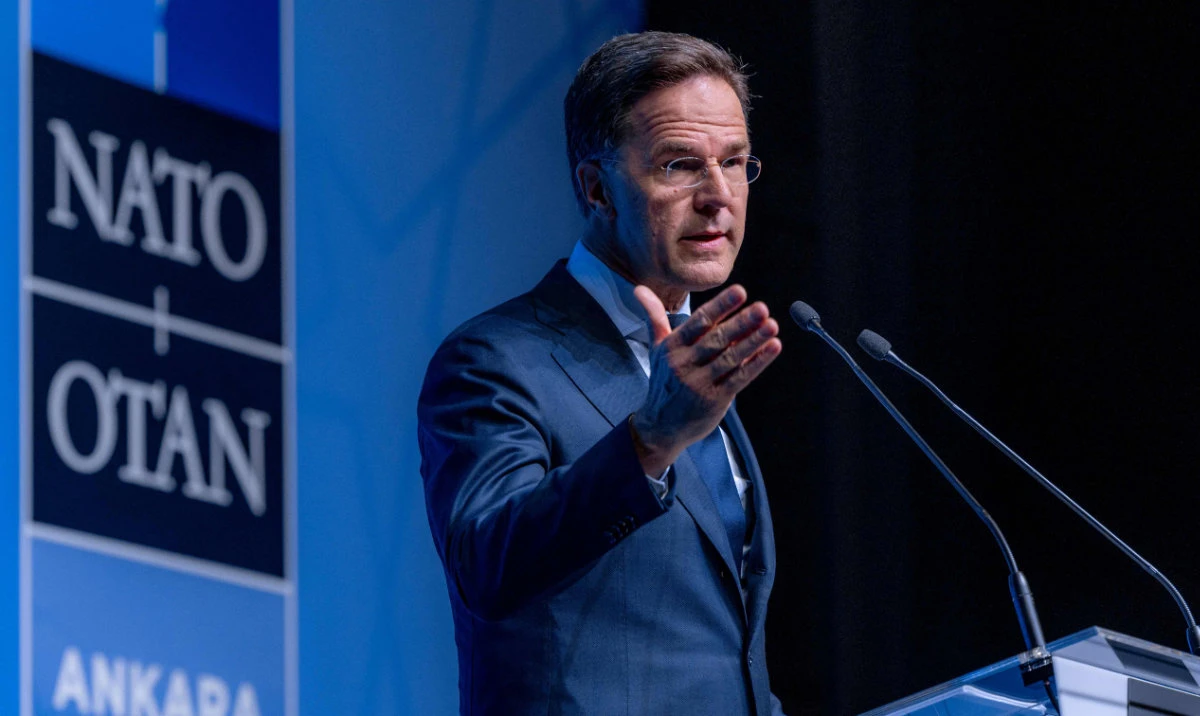

With NATO holding its annual summit in Ankara this week, the alliance faces a bigger challenge than either Russia or China: its members no longer share a coherent understanding of the values, economic order, geopolitical vision and legal principles it was created to defend.
Every enduring military alliance ultimately hinges on a deceptively simple question: What is it defending? Without a clear answer, it becomes reactive, defining itself by its adversaries rather than by a common purpose.
When NATO was founded in 1949, that purpose was clear. Emerging from the devastation of the Second World War, the alliance was established to defend what its founders called the “free world” against Soviet expansionism. More fundamentally, it sought to preserve a liberal international order built on four mutually reinforcing pillars: democratic governance, economic openness, the West’s geopolitical primacy, and international law based on the UN Charter.
Today, each of these foundations is under strain. Nowhere is this more evident than in the alliance’s political identity, weakened by democratic backsliding and rising authoritarianism. NATO may remain the world’s most powerful military bloc, but its moral legitimacy depends on whether its members continue to embody the democratic values they espouse.
The response of many NATO governments to Israel’s military campaign in Gaza has exposed the widening gap between the alliance’s stated values and its members’ policies. While the International Court of Justice and the International Criminal Court continue to examine allegations of genocide and other grave violations of international law, several leading NATO members — most notably the US — continue to provide the Israeli government with political support and political cover.
But an alliance whose historical legitimacy is rooted in the postwar rejection of fascism and genocide cannot afford to appear selective in its defense of universal humanitarian principles. Moral consistency is not an ethical luxury, it is a strategic asset that NATO abandons at its peril.
The liberal economic order is also under growing pressure. Ironically, its greatest challenge has come not from NATO’s adversaries but from its own members, as protectionism, tariff wars and the politicization of international trade have undermined the rules-based system that Western countries spent decades building and sustaining after 1945.
Meanwhile, the global economy’s center of gravity has shifted decisively toward Asia. When NATO was established, its members accounted for roughly two-thirds of world gross domestic product. Their share has since fallen to less than half, as Asia has emerged as the global economy’s principal growth engine.
The third pillar of the postwar order — geopolitical leadership — has become equally fragile. The Cold War provided NATO with a clear strategic framework. After the Soviet Union’s collapse, however, the assumption that US predominance would endure became conventional wisdom, underpinning successive rounds of NATO enlargement and reinforcing the belief that military superiority alone could shape international outcomes.
Moral consistency is not an ethical luxury, it is a strategic asset that NATO abandons at its peril.
Ahmet Davutoglu
The war in Afghanistan exposed the limits of that assumption. Following the Sept. 11, 2001, attacks on the US, NATO undertook the largest and longest military operation in its history. Yet despite two decades of overwhelming military and technological superiority, the Taliban returned to power. The lesson was not that force had become irrelevant, but that battlefield success cannot substitute for political strategy. Lasting security requires diplomacy, institution-building, regional engagement and long-term political vision.
That lesson is even more relevant in today’s multipolar landscape. While deterrence remains indispensable, Cold War frameworks no longer fit a world shaped by economic coercion, migration, energy insecurity, technological competition and cyberwarfare. NATO must therefore complement military strength with geopolitical foresight and sophisticated statecraft.
Europe’s own strategic contradiction has become increasingly difficult to ignore. Ukraine, the Black Sea and the Middle East now form a single, interconnected zone of instability, yet the EU continues to exclude the one country positioned at the crossroads of all three: Turkiye.
A Europe seeking strategic autonomy cannot afford to remain strategically fragmented. Finland and Sweden’s accession strengthened NATO’s northern flank, but Europe’s southern security architecture now depends on integrating Turkiye into the EU’s political institutions as well as its security ones.
Lastly, the international legal order is increasingly giving way to great power politics. The credibility of any alliance rests on its willingness to uphold the norms it proclaims. Yet US President Donald Trump’s threats to take over Greenland — an autonomous territory of Denmark — challenged one of the UN Charter’s core principles: the territorial integrity of sovereign states. When NATO’s leading power threatens the sovereignty of one of its own members, the alliance’s commitment to international law rings hollow.
These structural challenges are compounded by a widening rift over NATO’s strategic purpose. To be sure, disagreements among allies are not new. The Iraq War, for example, deeply divided the US and its European partners, but both sides continued to regard NATO as indispensable for transatlantic security. Today’s disagreements are more fundamental. Under Trump, the US has increasingly treated NATO as a transactional arrangement, making major foreign policy decisions without consulting key allies.
The Iran war is a case in point. The conflict, which could reshape the regional security landscape and has profoundly disrupted the global economy, carries profound implications for every NATO member, yet the alliance itself appears to have played no role in the decision-making process. An alliance whose members can be drawn into a regional conflict they neither collectively chose nor politically endorsed risks undermining the mutual trust required for security cooperation.
Given that NATO’s crisis is one of identity rather than capability, revitalizing it requires more than higher defense budgets or stronger deterrence. NATO needs a renewed normative foundation grounded in democratic legitimacy and human rights, a recommitment to international law and an economic vision suited to an era of shifting global power.
These must not be regarded as separate agendas. Without a coherent strategic philosophy centered on democratic legitimacy, human rights and the rule of law, NATO risks becoming little more than an instrument of shifting national interests. The alliance’s future ultimately depends less on the external threats it confronts than on its ability to redefine what the transatlantic community stands for and what, ultimately, it seeks to defend.
• Ahmet Davutoglu is a former prime minister (2014-16) and foreign minister (2009-14) of Turkiye.
©Project Syndicate


