


NEELUM VALLEY, Azad Kashmir: Raja Shahid Ali Khan stood on the banks of the Neelum River in Azad Kashmir earlier this week, watching a kite drift across the water into Indian-administered territory on the other side.
Beyond the river, visible from where he stood, was the village where he was born. Somewhere near the cluster of homes on the opposite bank lay the grave of his younger brother, Raja Liaqat Ali Khan, whose funeral he had watched from afar days earlier because he could not cross the border to bury him.
In parts of the Himalayan valley of Kashmir, divided families can still see each other across mountains, rivers and valleys but remain separated by the heavily militarized Line of Control (LoC), the de facto border that splits the disputed region between Azad Kashmir, administered by Pakistan, and Jammu and Kashmir, by India.
Arab News traveled with Khan nearly 95 kilometers from Muzaffarabad, the capital of Azad Kashmir, to the village overlooking Keran, where he repeatedly tried to identify his brother’s grave across the border on the Indian side.
At times, he stopped speaking altogether, staring across the river toward the homes he left behind decades ago.
“We could not give him a shoulder,” Khan, 49, told Arab News quietly as he sat beside the river near the divided village of Keran.
“Our whole family was here, but we could only wave goodbye to him from across the river.”
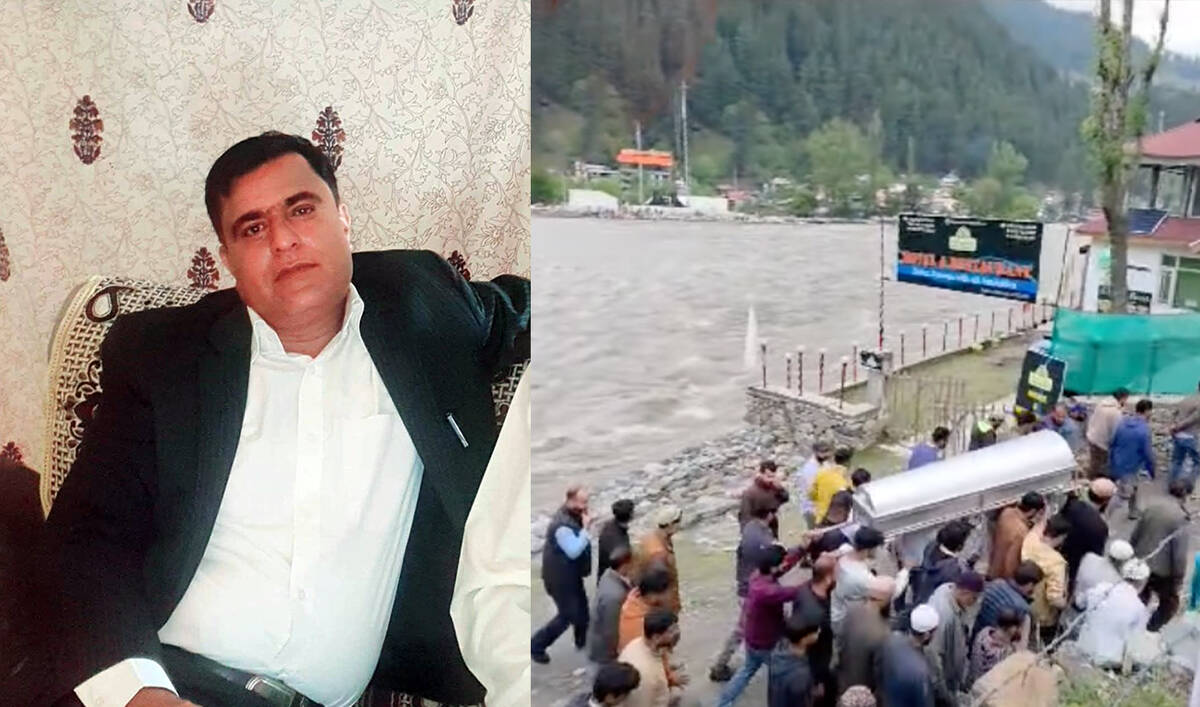
This collage of images shows Raja Liaqat Ali Khan (left) and people attending his funeral in Keran village of Indian-administered Kashmir, on April 25, 2026. (Courtesy: Raja Basharat)
Last month, as Liaqat’s body was carried through the village of Keran on the Indian side, hundreds of relatives gathered across the river in Azad Kashmir to watch the funeral from afar.
Videos shared widely on social media showed mourners standing silently on opposite sides of the river separating the two parts of the village.
“There were about a thousand of us there,” Khan said. “But despite having eight brothers, not one of us could give him a shoulder.”
“FAR AWAY”
Muslim-majority Kashmir has been contested since nuclear-armed neighbors India and Pakistan gained independence from British rule in 1947. Both claim the territory in full but govern parts of it separately and have fought multiple wars over it.
For decades, the division has fractured families, marriages and entire communities, particularly in villages along the LoC where relatives sometimes live within visible distance of one another but cannot freely cross.
The issue has gained renewed attention since a four-day military confrontation between India and Pakistan in May 2025, which followed a deadly militant attack on tourists in Indian-administered Kashmir’s Pahalgam town. India blamed Pakistan for the attack, while Islamabad denied involvement and called for an independent international investigation.
Residents along the LoC say communication restrictions and border tensions since the conflict have made fragile family connections even harder to maintain.
Khan’s family was split in 1990 during a surge in militancy in Indian-administered Kashmir, when many residents fled across the LoC into Azad Kashmir.
His father, Raja Izhar Khan, had married three women and had 11 children, nine sons and two daughters. Liaqat, the youngest son from his father’s second wife, remained on the Indian side with his mother and uncle in the village of Keran because the family believed the separation would be temporary.
More than three decades later, they are still divided.
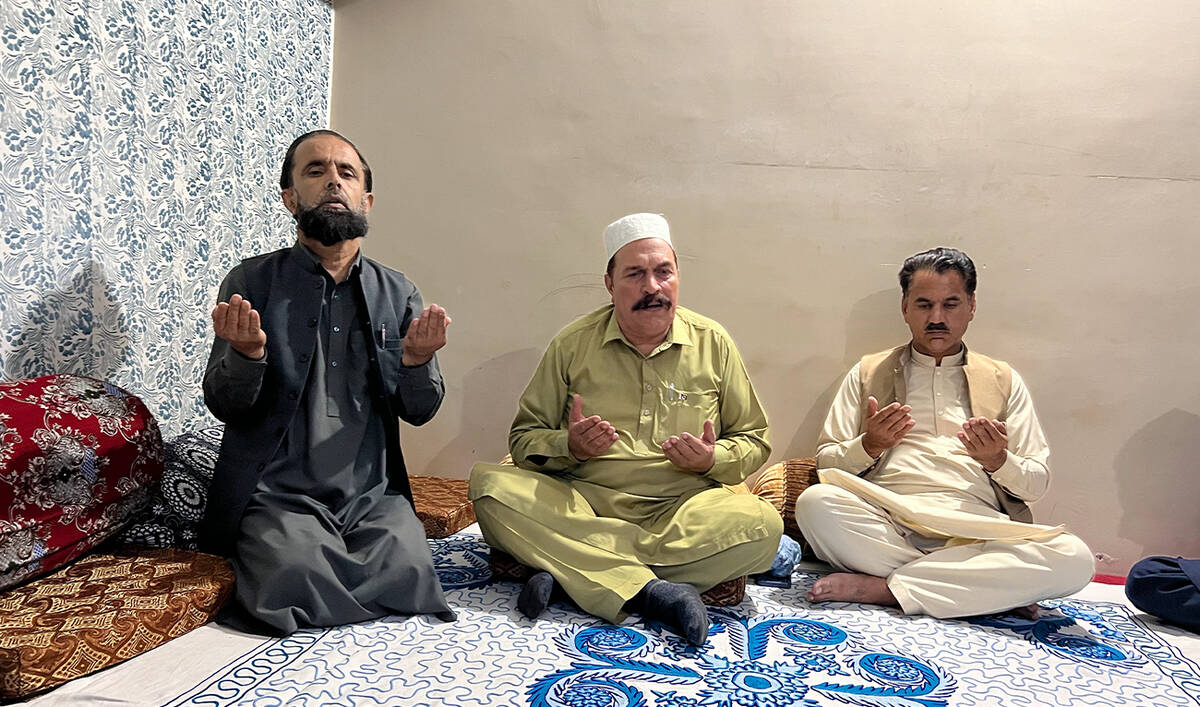
Raja Nisar Ahmed Khan (left) and family members offer prayers for their late brother, Raja Liaqat Ali Khan, at their home in Chehla Bandi Refugee Camp in Muzaffarabad city of Azad Kashmir region, Pakistan, on May 6, 2026. (AN)
Liaqat, who worked as a local administration official in Indian-administered Kashmir’s Ganderbal district, suffered a cardiac arrest last month and was hospitalized in Srinagar. He remained on a ventilator for several days before he passed on Apr. 25.
“We tried a lot to contact him, but we could not even talk to him,” another elder brother Raja Nisar Ahmed Khan said.
About the funeral he added:
“My sisters were crying ... My mother was sitting on the other side of the river. She was waving her hand and saying that Liaquat has left me.”
Over the years, India and Pakistan have introduced limited cross-LoC confidence-building measures, including bus services and trade routes, allowing some divided families to reunite after decades apart. But those channels have frequently been suspended during periods of political or military tension.
The brothers said contact between divided families has become increasingly rare in recent years, with communication often reduced to brief phone or video calls focused mainly on health and survival.
Raja Basharat Ali Khan, another of Liaqat’s brothers, said the family last spoke to him briefly on Eid Al-Fitr in March.
“He showed us his face for a few seconds. And the last thing he said was, ‘I am absolutely fine. And I hope you are fine too’,” Basharat recalled.
Weeks later, the family learned through social media that Liaqat had died.
“Our father always used to say that one day we would return home, but he left this world waiting,” Khan said.
He said the tragedy reflected the experience of countless divided Kashmiri families living along the frontier.
“Someone’s mother is there, someone’s son is here,” Nisar said.
“Every month, every week, we hear that someone has died. But we cannot see them.”
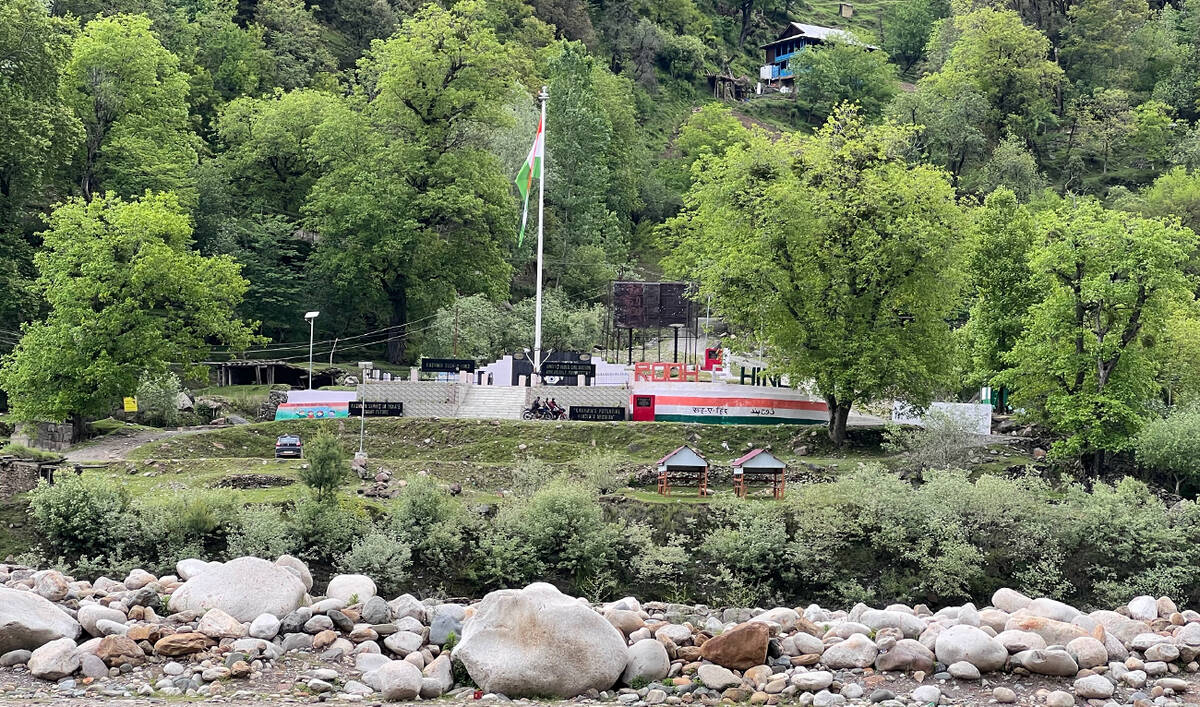
A photograph taken from the Pakistani side of the Line of Control shows the Indian flag flying over Keran village in Indian-administered Kashmir on May 6, 2026. (AN)
As evening shadows stretched across the Neelum Valley, Khan looked once more toward the opposite bank where the kite had disappeared into the mountains.
Softly, he recited a folk verse in his native language:
“Countrymen living on their native land are truly blessed,
While those far away long for home in remembrance.”


