
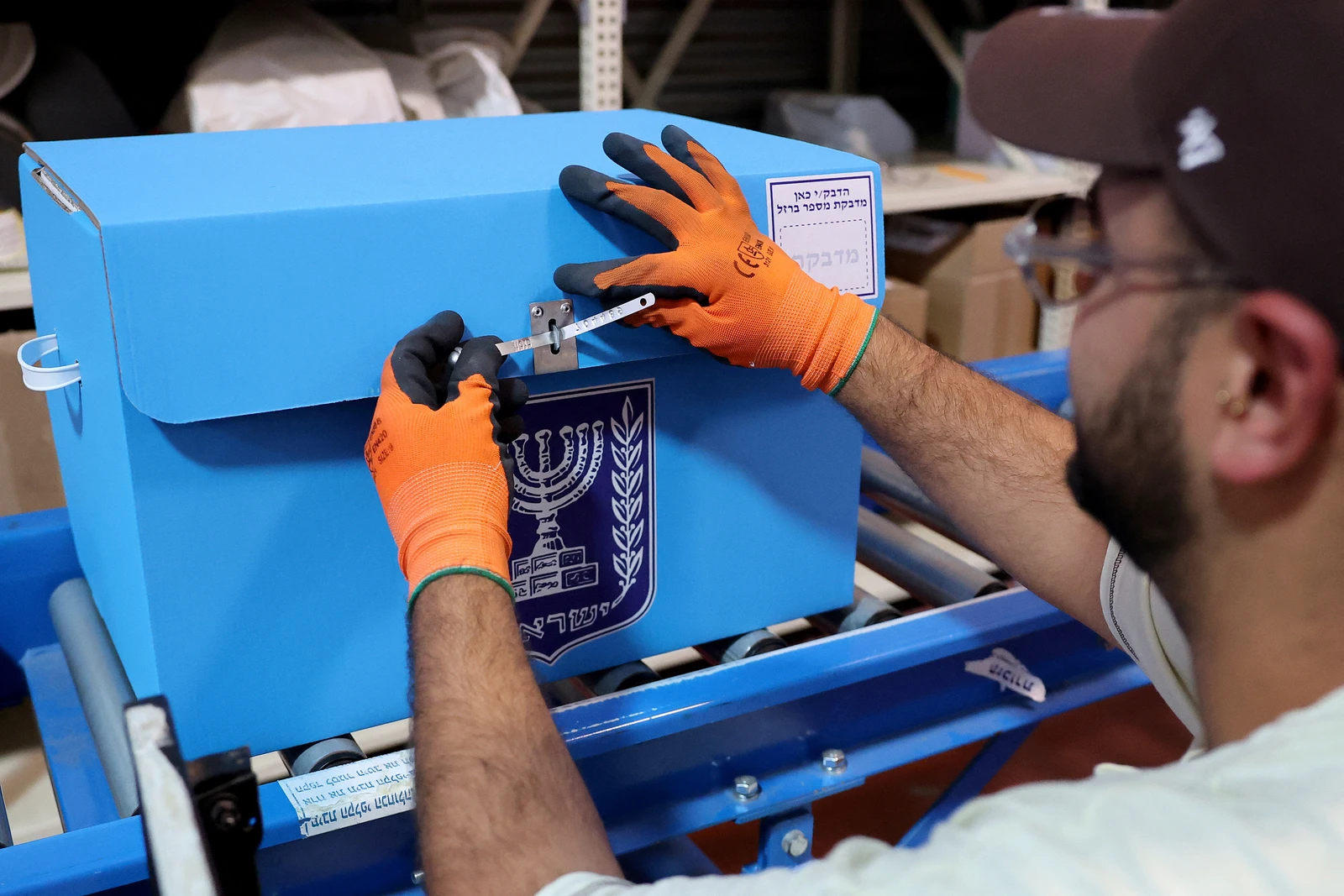

Ahead of one of the most anticipated general elections in Israel’s history, it has become almost impossible to decipher which issues could sway voters to switch their allegiance from one party to another. Even more difficult to predict is whether voters will move from supporting the governing coalition to backing the opposition bloc or vice versa when they head to the polls on Oct. 27.
On the face of it, it is incomprehensible that the parties currently comprising the government, which, from the outset of its tenure, embarked on undermining the country’s democratic system and was in power on Oct. 7, 2023, one of the darkest days for the Jewish people since the end of the Second World War, should still be serious contenders to retain power. But welcome to Israeli politics: what you see is not necessarily what you get.
What makes the picture even more murky is that the correlation between voters’ political positions on particular issues and their eventual voting choices does not necessarily follow the patterns one might expect.
For decades, a basic assumption among election analysts has been that both parties and voters behave rationally. In this context, rationality means voting in accordance with what they perceive to be their best interests or, in other words, seeking to maximize their benefits. With the rise of populism, however, it has increasingly been argued that populist politics reflects a form of voter irrationality, appealing more to our emotions than to our reason.
The more voters identify themselves as right-wing, the more likely they are to regard foreign affairs as the decisive issue
Yossi Mekelberg
In a country as diverse and polarized as Israel, even in the best of times but particularly after a profound national trauma that has activated deep-seated fears and distrust, distinguishing between rational and irrational motivations and using that distinction to predict voting behavior is more complex than ever.
To bring some order to our understanding of what primarily motivates Israeli voters, the Viterbi Family Centre for Public Opinion and Policy Research at the Israel Democracy Institute recently conducted a survey. Unsurprisingly, it found that the national mood had deteriorated, particularly regarding the future of democratic governance, national security, the economy and social cohesion.
Mood is an abstract but potentially powerful political force. Its effect on voting behavior depends partly on whom voters hold responsible for their growing pessimism. That responsibility is not necessarily attributed to those in power. Pessimism can also affect electoral turnout, as a lack of optimism may lead some people to stay at home rather than vote. In a closely fought election, participation is crucial and could make a significant difference to the composition of the next government.
The survey makes one thing clear: in a country where security or, more accurately, insecurity, reigns supreme, foreign affairs is the most important factor influencing voting choices among Jewish Israelis. The more voters identify themselves as right-wing, the more likely they are to regard foreign affairs as the decisive issue. For Palestinian citizens of Israel, by contrast, personal security takes precedence. Homicide rates in their communities have reached unprecedented and unacceptable levels, while the police have so far done very little to address the problem.
Secular, liberal and progressive Israelis feel under attack and increasingly defensive of the institutions and values they hold dear
Yossi Mekelberg
In Israel’s current political discourse, foreign affairs is understood primarily through the narrow lens of security. Security is, of course, a fundamental public good in any society, whether it means maintaining law and order at home or defending the country against external threats. In Israel, however, particularly among Jewish Israelis, the strong association between security concerns and support for the political right is largely framed in terms of military power: the ability to defend the country against, or inflict damage on, states and organizations perceived as hostile, wherever and whenever they pose a threat. Military strength is thus presented as the principal foreign policy tool for ensuring national survival.
Yet Israel’s most secure borders are arguably those it shares with Egypt and Jordan, both of which signed peace agreements with Israel decades ago. Nevertheless, voters appear remarkably resistant to the argument that peace agreements and diplomatic relations can be among the most effective guarantors of national security.
For those who identify themselves as left-wing, the leading priority is the position of political parties on religion, cited by 39 percent of respondents in this group. When this is combined with the 22.5 percent that prioritize parties’ positions on judicial reform, a clear picture emerges. These segments of Israeli society, whose share of the electorate has been declining, are deeply concerned with defending the country’s liberal democratic character against increasing religious influence in the public sphere.
More than ever, attempts by the current government to restrict judicial independence, weaken the system of checks and balances, and undermine the separation of powers, alongside its promotion of increasingly religious legislation, have left secular, liberal and progressive Israelis feeling under attack and increasingly defensive of the institutions and values they hold dear.
The question of religion is also closely connected to the issue of drafting ultra-Orthodox young men into military service, which ranks high among the priorities of voters who identify themselves as centrist or left-wing. This is a matter of practicality as much as principle. Many voters believe that religious parties wield disproportionate influence over the government and, consequently, over Israeli society, while securing financial benefits for their constituents that are not available to others. At the same time, most other Jewish Israelis are required to undertake compulsory military service from the age of 18, generally for two years for women and three years for men, followed by potentially extensive periods of reserve duty that can place them in harm’s way.
Ultra-Orthodox men have historically enjoyed broad exemptions from military service. This arrangement is particularly contentious given the relatively limited contribution of much of the ultra-Orthodox community to the country’s workforce and, hence, government revenues. For centrist and left-wing voters, particularly those in the middle class, but also for many on the right, this has become a crucial question of fairness and social cohesion, especially after several exhausting years of war and national uncertainty. For many, the issue could prove decisive when they cast their ballots.
As in other countries, the cost of living, the state of the economy and the identity of a party’s leader also influence voting decisions. Anyone visiting Israel quickly realizes how expensive everyday life has become. At the macroeconomic level, the economy has demonstrated considerable resilience despite three years of war. Yet the gap between the haves and the have-nots continues to widen — a development that, perhaps surprisingly, left-leaning parties have struggled to translate into electoral gains.
Prime Minister Benjamin Netanyahu, meanwhile, has succeeded in persuading many lower-income voters that the liberal, left-wing elite is responsible for their economic predicament, conveniently diverting attention from the fact he has spent roughly two decades in power, across several periods in office, without resolving many of the problems that continue to affect them.
The rational voter model, together with the findings of many opinion polls, would suggest that a government with such a record should lose support. The remaining question is whether that loss of support will be sufficient to bring about a change of government and, if it does, whether the resulting coalition will be sufficiently stable to remain in power for a full term.
Yossi Mekelberg is a professor of international relations and an associate fellow of the MENA Program at Chatham House. X: @YMekelberg


