
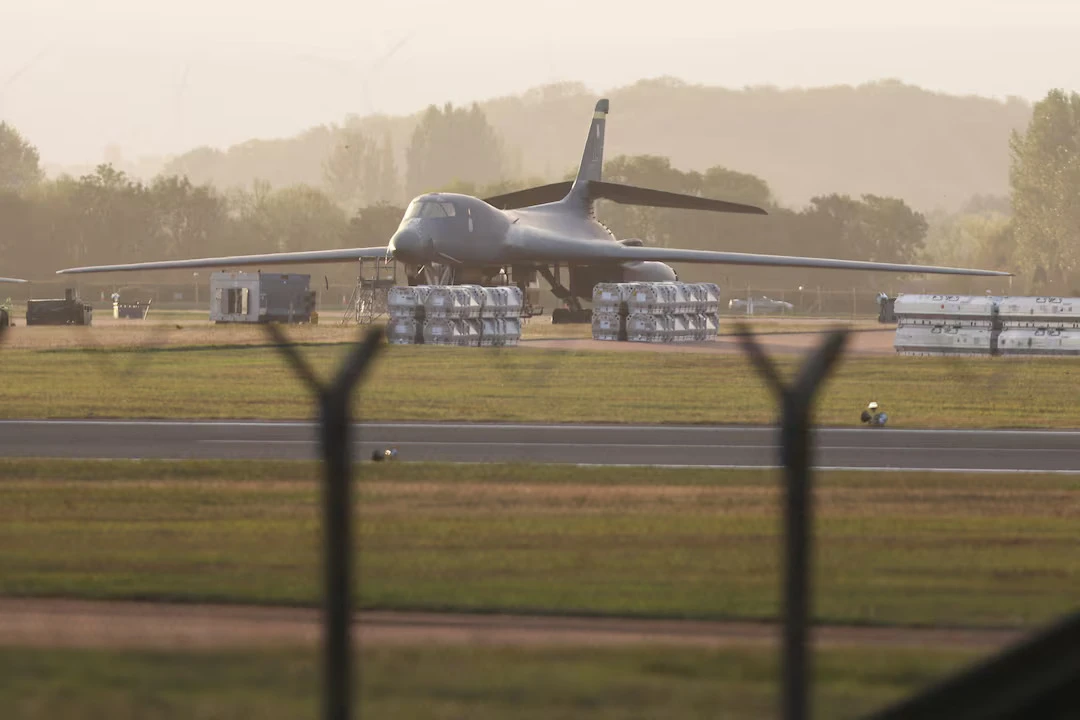

If there was no explosive material found in the suspicious vans, can we still call it a “suspected bomb plot” against an important airbase in Gloucestershire, England? Now that the five suspects who drove three vans in the dead of night and congregated in a village close to the airbase have been released on bail, surely the counterterrorism police must be confident they do not represent a threat to civil peace or the airbase used by the US Air Force.
If there were no bombs, no bomb-making material or weaponry and no suspects, then surely there was no major incident. Or is there something missing here?
Over 48 hours this week, the headlines in the world’s media told us that the Iran war had finally landed on British shores. President Donald Trump spoke with conviction as he said that a plot had been foiled and that US strategic bombers stationed in the UK were saved. Politicians like UK Prime Minister Andy Burnham, Foreign Minister Ed Miliband and Defense Minister Wes Streeting were quick to stress the readiness of the security forces to defend the realm, the country’s coordination with the US and the fact that all foreign agents or ploys against the country would be defeated.
Media reports and expert analyses suggested that Britain was under attack. But then the police announced the release of the suspects on bail, while stressing that the investigation was ongoing. Monday’s police statement added that offenses may have been committed, “knowingly or unknowingly,” on behalf of a foreign state. Iran is the most obvious suspect but a link to Russian threats, Islamist extremists or right-wing agitators should not be discounted. It is possible that these men — all British nationals from London, aged between 20 and 24 years old — were paid merely to drive three vans as close as possible to a military installation.
If there was even a remote possibility of a malicious act, those men should not have been released
Mohamed Chebaro
Many, like Trump, were surprised that the suspects had been bailed. If there was even a remote possibility of a malicious act, those men should not have been released. Unless of course they were just “white van men” traveling at night to start work early the next day on a building site, for example.
All indications point to the fact that the security operation around RAF Fairford was choreographed to instill confidence in the country and the solidity of its homeland security, resilience and defense readiness. But since the five suspects were released, all that has been brought into question.
The incident began when a local woman reported suspicious activity in the early hours of Sunday morning. She later claimed in a radio interview that a “large group of hooded and masked men” emerged from three large vans. The woman said she noticed that something “highly unusual was taking place” and attempted to contact the Ministry of Defense, but received no response.
The farmer dutifully contacted 999 at 1.36 a.m., as she was aware that RAF Fairford had been operating at a high security level at the time. Streeting later said he was grateful for her actions but said that she only had a “partial picture” of the situation.
In today’s geopolitical context, incidents like this one could ring alarm bells in the UK, the US and beyond. It goes without saying that counterterror investigators would look at the potential involvement of proxies.
What the police did not say was that the security and intelligence authorities have been operating in a highly volatile environment, in which verbal threats are on the lips of officials from Iran and Russia every day. In the last few years, the intelligence community has routinely spoken of dealing with so-called hybrid threats, acts of sabotage and criminal activities instigated by shady criminals commissioned by foreign agents or intermediaries, often for money instead of ideological conviction.
In today’s geopolitical context, incidents like this one could ring alarm bells in the UK, the US and beyond
Mohamed Chebaro
Some of the threats were linked to the Oct. 7, 2023, Hamas attacks against Israel and the Israeli reprisals against Gaza that followed. Other incidents related to Russian threats of retaliation against the UK and the wider West for their ongoing support of Ukraine. Over the past few years, these threats have multiplied and taken the shape of a complex web of deniable acts, including drone incursions around airports and other facilities, criminal acts of hacking, sabotage at logistics depots, and damage to train lines and transport hubs.
Over the past year, Iran has repeatedly threatened to step up its attacks on targets in the West. Ken McCallum, head of the UK’s domestic intelligence agency, last year revealed that security forces have “tracked more than 20 potentially lethal Iran-backed plots in just one year.”
In July, two Romanian nationals guilty were found guilty of stabbing an anti-Tehran regime Iranian journalist in London. The UK also proscribed the terror group Harakat Ashab Al-Yamin Al-Islamia in July after it claimed responsibility for a series of attacks, including the burning of four Jewish community ambulances in March.
All the above goes to say that, in this age of war and superpower tensions, all threats are perceived to be imminent and serious. The question of whether Iran, Russia or any radical group was plotting against or testing the readiness of the UK and the US, or whether the whole incident was a mere fever dream, remains open. What is very clear though is that conflicts are dangerously spilling over and getting closer to the UK and Europe every day.
Mohamed Chebaro is a British-Lebanese journalist with more than 25 years of experience covering war, terrorism, defense, current affairs, and diplomacy.


