
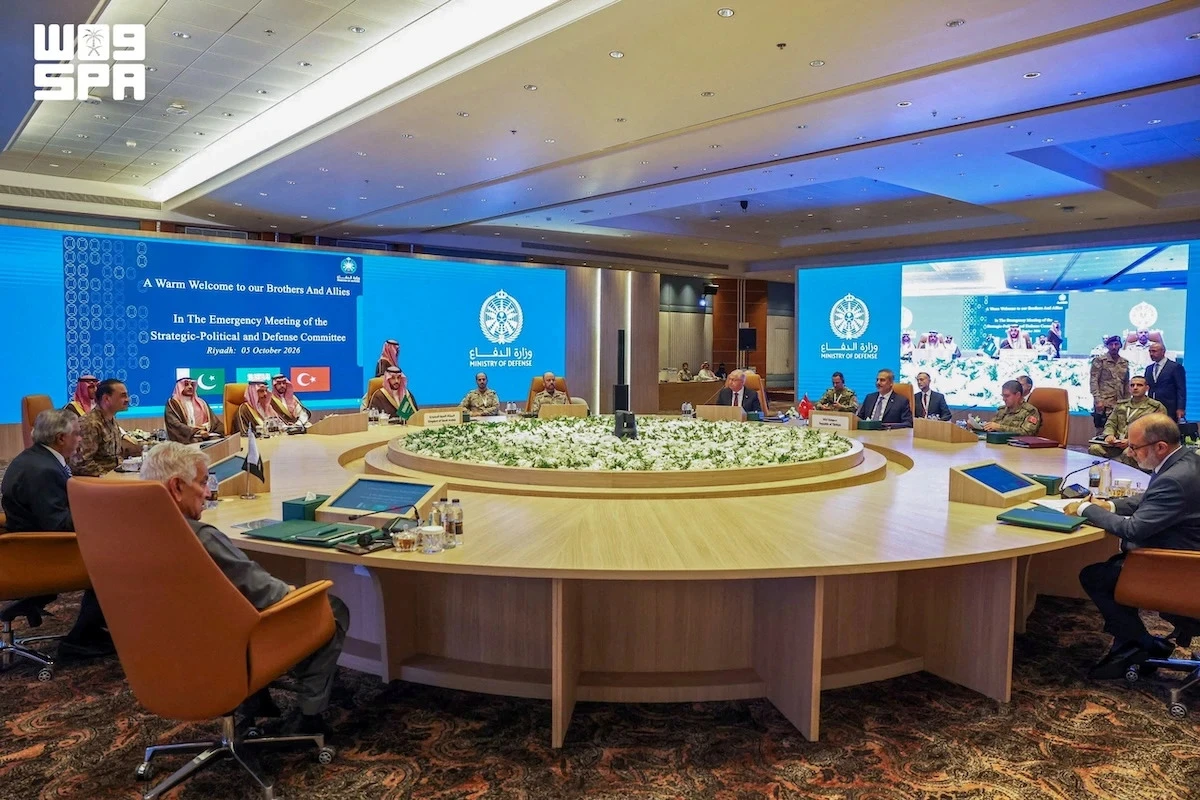

Just three months after its signing, the Saudi-Turkish-Pakistani Makkah Defense Alliance has taken a major step toward becoming a fully operational security partnership. Following renewed Houthi attacks against Saudi Arabia, the three nations last month agreed to activate their collective defense commitments and facilitate the rapid deployment of military forces and capabilities to the Kingdom.
Two further moves have added institutional weight to the pact, which was only signed in August: the appointment of retired Pakistani Lt. Gen. Nauman Mahmood as the alliance’s first secretary-general and Turkiye’s parliamentary ratification of the agreement last week. These developments came as Gulf states reassessed how much they can continue to rely on Western military guarantees. Because the ongoing regional conflict has exposed the limits of existing security arrangements, Riyadh and its partners appear to be laying the groundwork for a more autonomous regional defense architecture.
The agreement marks a clear departure from the mostly bilateral arrangements that have long underpinned Saudi Arabia’s defense ties with Turkiye and Pakistan. Its central provision — that an armed attack against one member is considered an attack against all three — establishes a formal collective defense commitment backed by real structure. A Strategic Political and Defense Committee and a permanent secretariat in Riyadh now provide dedicated channels for political consultation and military planning.
Riyadh and its partners appear to be laying the groundwork for a more autonomous regional defense architecture
Zaid M. Belbagi
Furthermore, appointing a Pakistani secretary-general for an initial three-year term signals that the organization is built to outlast the immediate crisis. This is an alliance designed to endure, not a mere communique drafted for the moment. Consequently, the October decision to implement collective defense measures serves as a vital stress test.
While earlier declarations of military cooperation rarely had to prove themselves in practice, this pact now faces real-world demands. It must demonstrate that it can coordinate capabilities across three distinct armed forces and translate political pledges into practical assistance. Thus, its credibility will depend on how well these mechanisms perform under pressure, rather than the ambition of its founding charter.
For Riyadh, this partnership offers a way to broaden its defense relationships in an increasingly unpredictable security environment. Although Saudi Arabia has invested heavily in military modernization, the sustained missile and drone campaign against the Kingdom has proved that advanced weapons systems alone cannot guarantee protection against prolonged assaults. To address this vulnerability, each partner brings distinct strengths to the table.
Turkiye offers an established military-industrial base, considerable operational experience and a growing capacity to manufacture defense technologies. Meanwhile, Pakistan contributes long-standing military ties with the Kingdom, alongside deep expertise in training and operational planning. Ultimately, the alliance’s true strategic value lies in how these capabilities complement one another.
Turning these assets into a credible deterrent will require sustained investment in interoperability and unified command structures
Zaid M. Belbagi
Over time, joint exercises, intelligence-sharing, military logistics and defense-industrial cooperation will steadily bolster the three nations’ ability to counter shared threats, while also supporting Riyadh’s drive to localize military production and diversify procurement. Nevertheless, turning these assets into a credible deterrent will require sustained investment in interoperability and unified command structures.
None of this suggests that Saudi Arabia is preparing to abandon American security guarantees. Despite recent strains, the Kingdom still relies heavily on US intelligence, advanced weaponry and military technology. Indeed, the strategic defense agreement signed with Washington in November 2025, along with subsequent US arms approvals, confirms that bilateral cooperation remains central to Riyadh’s security calculations. Moreover, Turkiye’s continued membership in NATO makes it difficult to view this new pact as an anti-Western bloc.
What is shifting, however, is the willingness of Gulf governments to depend on a single external protector. Specifically, the Makkah Agreement gives Saudi Arabia an additional framework to mobilize military support alongside partners that have a direct stake in regional stability. Rather than signaling disengagement from Washington, this move reflects strategic diversification. Over time, it could foster a more distributed security architecture in which regional states hold greater sway over defense planning and crisis response, while preserving vital Western alliances.
For the wider Gulf, meanwhile, how this pact integrates with existing Gulf Cooperation Council defense mechanisms will be critical. The GCC already maintains collective security frameworks, such as the Peninsula Shield Force, though their effectiveness and integration have long faced challenges. Consequently, bringing two major non-GCC military powers into a trilateral framework could reinforce these structures by adding fresh capabilities and avenues for coordination, provided their overlapping responsibilities are clearly defined to avoid complicating crisis decision-making.
Far from replacing the Gulf’s Western partnerships, the Makkah alliance instead hedges against overreliance on them. Riyadh’s task now is to ensure the pact strengthens regional defense cooperation without fragmenting it. If it succeeds, the Makkah Defense Alliance will be remembered less as a departure from the past and more as the moment Gulf states began truly taking ownership of their own security
Zaid M. Belbagi is a political commentator and an adviser to private clients between London and the Gulf Cooperation Council. X: @Moulay_Zaid


