- Oman-Iran Strait of Hormuz management talks are at an advanced stage, Qatar says
- Pakistani Defense Minister Khawaja Asif said “things are shaping up again in favor of a peace arrangement"
DUBAI: Iran and the United States did not discuss extending a ceasefire because Tehran does not consider the arrangement to have had a defined start date, a senior Iranian source told Reuters on Wednesday, casting fresh doubt on efforts to revive an agreement between the two sides.
The comments came after Pakistan said on Tuesday that the United States and Iran were close to “some sort” of deal and Qatar said talks on managing the Strait of Hormuz were at an advanced stage, suggesting diplomatic efforts were continuing despite reports of attacks on shipping in regional waters.
The Iranian source's comments indicate that Tehran does not view the issue as one of simply extending a time-limited ceasefire. Iran has instead continued to focus on the implementation of commitments it says were made under the June arrangement.
In an interview with Bloomberg News, Pakistani Defense Minister Khawaja Asif said “things are shaping up again in favor of a peace arrangement or a deal.”
“The signals in the last two three days are that we are close to some sort of an arrangement.”
Iranian Foreign Minister Abbas Araghchi met Pakistani Interior Minister Mohsin Naqvi in Tehran on Tuesday, Araghchi’s Telegram channel said on Tuesday, without providing further details.
Pakistan’s interior minister is visiting Iran to discuss regional security, stability and other developments, the foreign office said on Wednesday.
“He is discussing bilateral relations, security, regional security and stability, and constructive engagement among the parties in the region and regional developments,” foreign ministry spokesman Tahir Andrabi, whose government has been mediating to end the fighting in the Middle East, told reporters in Islamabad.
Qatar’s Foreign Ministry spokesperson told a briefing earlier on Tuesday that separate discussions between Oman and Iran over management of the Strait of Hormuz were at an advanced stage.
Iran’s Foreign Ministry’s Public Relations Office did not immediately respond to a call for comment.
Pakistan and Qatar have been the main mediators in the conflict in which thousands have been killed — mainly in Iran and Lebanon — since US and Israeli attacks on Iran on February 28. Iran has hit back by striking US assets and infrastructure in countries including Oman, Jordan, Kuwait, Israel, the UAE and Saudi Arabia.
Oil fell back on Tuesday after hitting a one-week high earlier in trading although it remains much higher than before the war.
Iran said on Sunday it was nearing a final pact with Oman defining new shipping lanes in the Strait of Hormuz, which runs between them, but said that in itself would not open the waterway unless the US met certain conditions.
Those conditions were largely in line with a memorandum of understanding to end the conflict that was reached between Washington and Tehran in June and included compensation and an end to sanctions and military threats.
Araghchi said on Sunday that Tehran and Washington were not holding direct talks, but that messages were being exchanged through intermediaries.
US President Donald Trump responded on Monday night, making new demands, saying he was seeking his own reparations from Tehran, seemingly leaving the two sides deadlocked.
Two vessels struck
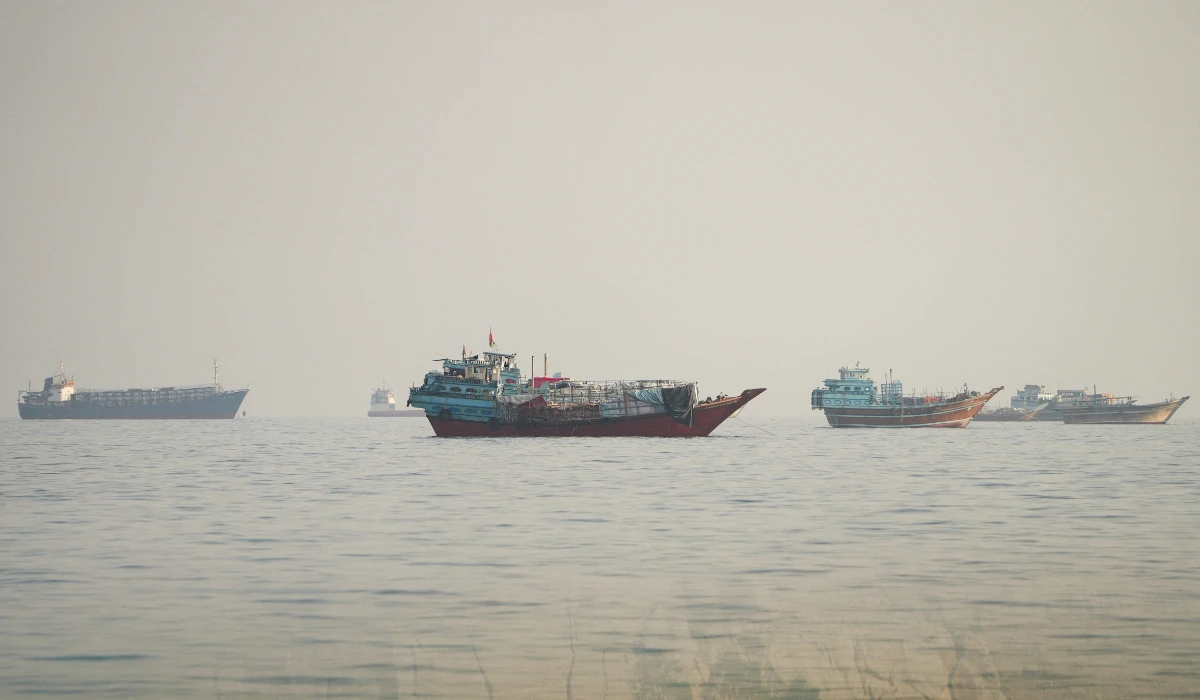
Despite tentative signs of progress in diplomacy, there were reports of new attacks on shipping in the Gulf of Oman and the Red Sea, highlighting the widening threat to maritime trade.
Four crew members were killed in an attack by Yemen’s Iran-backed Houthis on a small cargo vessel in the Bab Al-Mandeb strait on Tuesday, Yemen’s Transport Ministry said.
The fatalities aboard the Egyptian-owned Tihamah are the first deaths in a Houthi strike on shipping since the Iran war began.
A container ship was also hit by a missile off Pakistan, while sailing through the Gulf of Oman in a suspected US attack, sources said.
The Wall Street Journal reported a US official as saying that the ship had been hit by a US military helicopter after its crew ignored warnings from personnel working to enforce a naval blockade on Iranian ports.
The US first announced a blockade of shipping trying to reach Iran’s ports in April and reimposed it in July after the June peace accord crumbled.