


SHARDA, Neelum Valley: Two goats slowly make their way up the stone steps of an ancient site as cool winds sweep through the lush green slopes of Sharda town in Azad Kashmir’s Neelum Valley while much of Pakistan’s plains bake in the summer heat.
Tourists pause nearby to take photographs of the centuries-old remains of the Shri Sharda Mata Shakti Peeth Temple, now scattered across a ridge, with a Pakistani flag fluttering above a military checkpost overlooking the valley and the Line of Control, the de facto border dividing the Himalayan valley of Kashmir between Pakistan and India.
Few places capture Kashmir’s layered history quite like this remote valley, where traces of Buddhism, Hinduism and ancient scholarship sit against the backdrop of one of the world’s most militarized disputes.
The renewed attention around the site comes days after Pakistan and India marked the anniversary of their most serious military confrontation in decades, underscoring how deeply the Kashmir dispute continues to shape relations between the nuclear-armed neighbors.
For researchers, activists and residents of the valley, however, the centuries-old ruins of the Hindu temple are not only a reminder of Kashmir’s religious and intellectual past, but also of what many see as a lost possibility for cross-border connection between divided communities on both sides of the Line of Control.
Years ago, Dr. Rukhsana Khan, head of the Sharda Center of Learning, Archaeology and Cultural Heritage at the University of Azad Jammu and Kashmir, prepared a feasibility study proposing Sharda as a potential site for confidence-building between India and Pakistan, centered on controlled religious and academic access across the LoC.
While the temple remains inaccessible for many devotees across the border, Hindus in Pakistan visit Sharda Peeth as tourists and perform rituals at the revered site.
“Before 2016, people used to come from the other side, including Hindus,” Wasi Khawaja, a social activist from Neelum Valley, told Arab News, urging resumption of that facility.
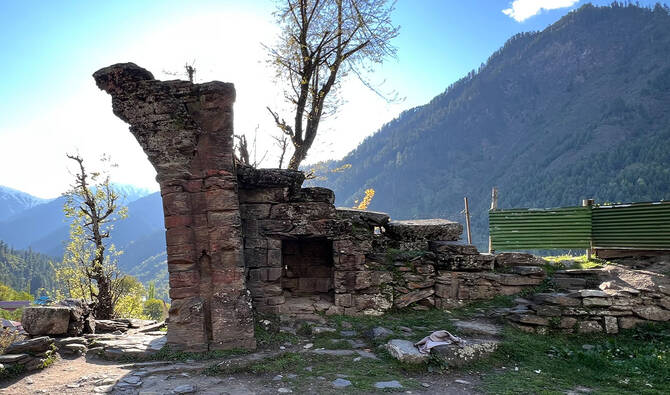
The photograph taken on May 7, 2026, shows the entrance of Shri Sharda Mata Shakti Peeth Temple in Neelum Valley of Pakistan’s Azad Kashmir region. (AN Photo)
Tensions between Pakistan and India rose after the killing of Kashmiri separatist leader Burhan Wani on July 8 that year, which escalated severely after a September 18, 2016 militant attack on an Indian army base in Uri that killed 19 soldiers.
India blamed Pakistan for the attack, an allegation denied by Islamabad. The incidents led to a significant freezing of bilateral relations.
Activists and researchers urge that pilgrims from the other side of the LoC should be allowed to visit Sharda Peeth, seeking a mechanism similar to the Kartarpur Corridor between Pakistan and India that allows Indian Sikh pilgrims visa-free access to one of their most revered shrines in Pakistan’s Punjab.
“When we talk about the [Kartarpur] corridor, it is something between two international borders,” Khan said. “In the context of Kashmir, the corridor is not applicable. It is all about the movement of communities within the state of Jammu and Kashmir.”
Many envision a controlled crossing mechanism allowing divided families and pilgrims to travel across the frontier.
Danish Irshad, a journalist who has authored a book on Azad Kashmir’s history named ‘Azadi Ke Baad,’ linked the idea to proposals once floated by Kashmiri leaders for the disputed region to act as a buffer zone between India and Pakistan.
“[Former AJK President] Sardar Ibrahim wrote in Kashmir Saga that the state could become a buffer zone between India and Pakistan,” Irshad recalled. “There is always a threat of war because of this dispute, so reducing tension here can help the whole region.”
“RELIGIOUS HARMONY”
The Himalayan territory has been divided between Pakistan and India since their independence from British rule in 1947. Both countries claim the region in full and have fought multiple wars over the region.
For locals like Malik Iftikhar Ahmed, a historian who grew up just a short walk from the Shri Sharda Mata Shakti Peeth Temple, the site is more than an archaeological landmark and is part of their everyday memory, layered with stories of pilgrims, scholars and generations who saw the valley as a meeting point of civilizations rather than a frontier.
“Among the oldest books we have on the history of Kashmir, one is the Nilamata Purana. In it too, this is mentioned as Sharda temple,” Ahmed told Arab News.
“And in the 11th century AD, Rajatarangini, written by Pandit Kalhana, also mentions this as a temple. However, in some [other] books, it is said that it was a [site] of Buddhism before the 7th century.”
The ancient site, also commonly referred to as Sharda Peeth, is revered by many Hindus as a temple dedicated to Hindu goddess Saraswati.
Researchers say the ruins visible today likely date back to the 7th or 8th century, though archaeological evidence suggests the site existed much earlier.
Dr. Khan said excavations between 2012 and 2014 had uncovered Kushan-era coins, terracotta pipes, inscriptions and other artifacts pointing to Buddhist monastic activity.
“So, we can say that this place remained one of the important and key centers of Buddhism during the Kanishka period,” Khan told Arab News.
“The present structure was reconstructed during the era of King Lalitaditya Muktapida in the 7th century.”
The Neelum Valley historically connected Kashmir with Central Asia and ancient Silk Road routes used by monks and traders.
“We have very valid evidence recording the Buddhist monks who used to travel from today’s Khyber Pakhtunkhwa toward Kashmir via this Neelum and Jhelum valley,” she said, referring to the accounts of Chinese monk Xuanzang who traveled through the region centuries ago.
This valley is also associated with the ancient Sharda script, which originated in Kashmir around the 7th-8th century and was primarily used for Sanskrit and Kashmiri across northwestern India, according to Khan. The script is considered a key element of Kashmir’s intellectual and literary tradition.
“It is very pertinent for any civilization that they have their own script,” the archaeologist said, adding that the temple was once known as ‘Shardapeeth,’ or the ‘Great Center of Learning,’ while Kashmir was called ‘Sharda-desh’ because of this place.
For residents of the valley, the debate is not only about religion or archaeology, but about whether Kashmir can ever become a bridge instead of a battleground for the two neighbors.
“When the situation gets bad here, only people living on the border know what happens,” Ahmed said. “When religious harmony is established, border communities also live in peace.”


