


BEIRUT: For years, Lebanon’s refugee camps were characterized by overcrowding, poverty and political neglect. Now, two months into the renewed conflict between Israel and Hezbollah, they have become places of relative refuge in a sea of destruction — even as they strain under a fast-growing influx of displaced people.
Since March 2, when Israel launched its military campaign in southern Lebanon after Hezbollah fired rockets after the Feb. 28 US-Israeli strikes on Iran, the Lebanese-Palestinian Dialogue Committee moved quickly to reaffirm support for displaced families.
The committee, which manages relations between the Lebanese state and the Palestinian refugee camps, worked to secure minimum conditions for survival under an emergency response plan, even as it knew the available aid would fall far short of the needs.

The scale of the displacement is stark. As of April, the committee had recorded 5,391 displaced families, or 22,033 people, sheltering in camps, surrounding communities and emergency centers run by the UN Relief and Works Agency for Palestine Refugees (UNRWA). According to the UN Children’s Fund, UNICEF, 7,813 were children.
Among the displaced were 1,299 Lebanese, 3,101 Palestinians, 410 Palestinian refugees from Syria, 404 Syrians, 16 stateless people and 18 people of undocumented nationality.
Those new arrivals are joining communities that were already stretched thin. According to the last full census, conducted in 2017 by Lebanon’s Central Administration of Statistics in coordination with its Palestinian counterpart, about 225,000 people were living in the 12 official camps and surrounding clusters. Of those, 73.6 percent were Palestinian.
The camps are administered internally by Palestinian factions under informal arrangements dating from the 1969 Cairo Agreement, which Lebanon later scrapped after years of bloodshed linked to the presence of Palestinian arms on its territory.
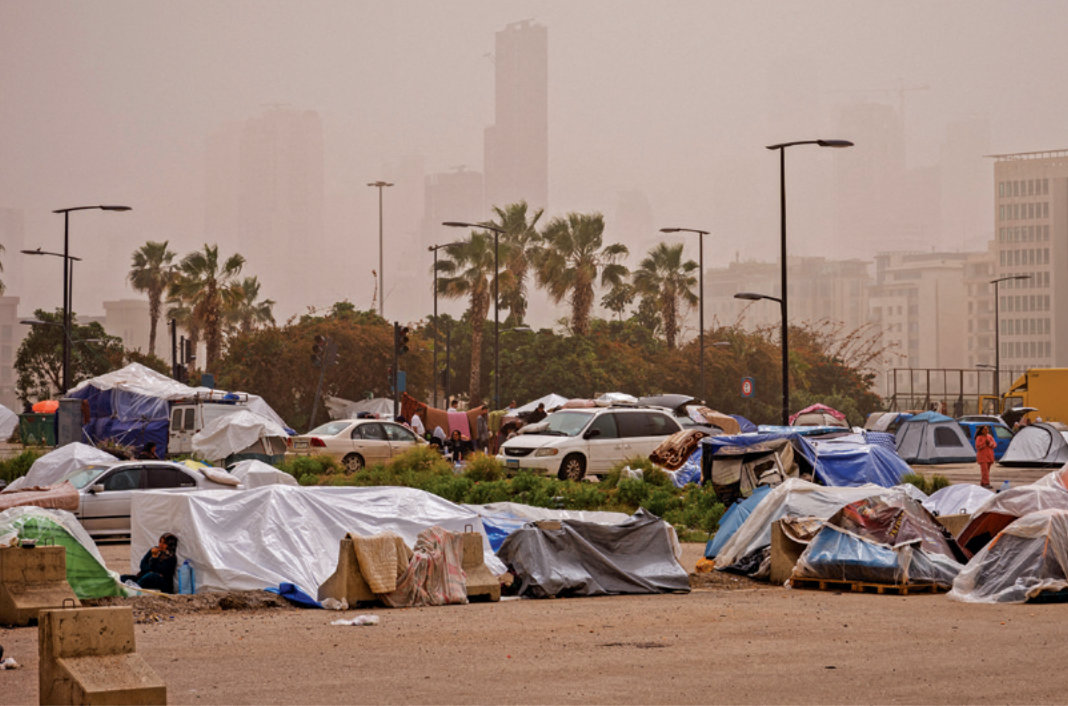
Displaced people rest outside their tents at an unofficial camp erected along Beirut's seafront area during a sandstorm on April 3, 2026. (AFP)
The Lebanese army and security forces do not enter the camps, but they maintain a tight perimeter around them.
That unusual status has helped produce a wartime paradox. By May 5, UNRWA said 1,132 displaced people, or 328 families, had registered at its two emergency shelters, up by 951 people in a single week.
The surge followed Israeli evacuation orders for villages in southern Lebanon.
The numbers are likely to further increase, as Israel on May 9 issued new evacuation orders for nine villages in southern Lebanon, resuming its bombing campaign despite a US-mediated ceasefire in place since mid-April.
The Israeli military says it is targeting Hezbollah infrastructure. Earlier on May 9, it said it struck more than 85 Hezbollah targets in southern Lebanon within 24 hours, as well as an underground weapons site in the Bekaa Valley, The Times of Israel reported.
However, Lebanon’s Ministry of Public Health says the vast majority of those killed in Israeli attacks were civilians. Rights groups and international NGOs condemned Israel’s attacks on civilian infrastructure and residential areas.

Diggers remove the rubble of buildings destroyed in Israeli strikes as they look for survivors buried underneath in the southern Lebanese coastal city of Tyre on April 21, 2026. (AFP file photo)
This is not the first time the camps have absorbed displacement from outside. They had already taken in about 27,000 Palestinian refugees from Syria who fled during Syria’s civil war, most of them settling in the sprawling Ain Al-Hilweh camp near Sidon.
Now, with the ceasefire collapsed and fighting resumed, camps in the south and in Beirut’s southern suburbs have largely escaped direct strikes, turning them, paradoxically, into refuges for Lebanese and others fleeing nearby villages. Residents say the shift has been especially visible in Tyre, south of the Litani River.
“Every camp is seeing an economic boom,” said Abu Raafat, a Palestinian resident of one of the Tyre camps.
“People from the surrounding areas, especially around Tyre, are doing their shopping inside Al-Bass camp,” he told Arab News. “Some have set up businesses here after their shops were destroyed or because going back to their villages, with the Israeli bombardment, just is not possible.”
However, he noted that “there is huge pressure — not a single room left to rent.”
That sense of revival might be misleading. Conditions in the camps were already dire before the war, shaped by years of economic collapse, currency meltdown and a sharp decline in UNRWA’s ability to provide basic services.
The latest influx is pushing an already brittle environment closer to rupture.
“The Palestinian camps have become safe zones compared to what’s around them,” Hisham Debsi, director of the Tatweer Center for Strategic Studies and Human Development and a Palestinian researcher, told Arab News.
“Everyone is investing in them now — for better and for worse.”
Still, not all the camps have been spared the ongoing violence. The area around Ain Al-Hilweh was hit by direct Israeli airstrikes in March, killing people and causing widespread damage.
The perimeter of Burj Al-Barajneh camp in Beirut’s southern suburbs was struck by heavy raids that forced families to flee. Beddawi camp in the north was also targeted, with casualties reported.
The damage has deepened an economic crisis that was already severe. According to the Tahrir Institute for Middle East Policy in Beirut, the war has frozen commercial activity in the south and wiped out jobs in agriculture, construction and tourism — sectors that employ thousands of Palestinian workers.
At the same time, the conflict has pushed a longstanding political issue further into the background: Palestinian arms in Lebanon.
The handover of Palestinian weapons to the Lebanese state, part of a broader effort to consolidate arms under government control, completed its fifth phase late last year, when Palestinian National Security forces in Ain Al-Hilweh transferred a batch of heavy Palestinian Liberation Organization weapons to the Lebanese army.

Lebanese army soldiers stand guard as a truck loaded with boxes of weapons handed over by Palestinian groups prepares to leave the Burj al-Barajneh camp in Beirut's southern suburbs on August 29, 2025. (AFP)
Hamas, Islamic Jihad and their allies, however, have refused to join the process, tying any disarmament of their fighters to Hezbollah’s disarmament.
Debsi said the PLO-led initiative remains in place in coordination with the Lebanese government, but the war has pushed it down the priority list.
Even so, political coordination has not stopped. Debsi said engagement continues through direct contact with the president, the prime minister, and Lebanon’s military and security leadership.
He said that coordination rests on ties between Palestinian security forces and their Lebanese counterparts, as well as trust between the state, PLO-affiliated factions and the Palestinian Authority’s embassy in Beirut.
By contrast, the Lebanese government does not engage politically with Hamas or Islamic Jihad, Debsi said, in line with the cabinet’s decision to place arms under state control.
Contact is limited to security channels, and Beirut has rejected the creation of joint committees with either group that could amount to a backdoor form of political representation.
Beyond politics, the war is surfacing inside the camps in quieter but more troubling ways.

Mourners carry one of two coffins, the day after two people were killed in an Israeli strike on the Palestinian refugee camp in Ain al-Hilweh, near the coastal city of Sidon, in southern Lebanon on February 21, 2026. (AFP file photo)
Obituaries appear from time to time on social media for Palestinians killed in the fighting in the south. The latest were Tareq Yousef and Louay Nimr, mourned on May 7. Both were from Burj Al-Shamali camp near Tyre.
Sources told Arab News that the two young men were members of Islamic Jihad.
Reports had already emerged of dozens of young Syrians being killed, many believed to have been working as agricultural laborers in southern Lebanon.
That raises urgent questions: Is Hezbollah recruiting young Palestinian and Syrian refugees to fight alongside its forces? And what are the risks of exploiting communities already battered by poverty and limited opportunity, as happened in Nahr Al-Bared, a northern Lebanon camp, in 2007?
Palestinian and Syrian fighters are being deployed alongside Hezbollah on the ground, Palestinian sources told Arab News. Even so, conflicting reports continue to circulate about the scale and significance of that involvement.
At the same time, some observers say attitudes in the camps are shifting. After years of violence and instability, many Palestinians now view weapons as a liability rather than a source of protection and want an end to the bloodshed.

Palestinian fighters stand with their arms in the Burj al-Barajneh camp for Palestinian refugees in Beirut's southern suburbs on August 21, 2025 as the armed Palestinian groups in the camps start handing over their weapons to the Lebanese authorities following a deal reached in May. (AFP file photo)
“The Palestinian factions close to Hezbollah are well known,” a Palestinian source in one of the southern camps said. “Besides Hamas and Islamic Jihad, there is the Popular Front founded by George Habash and the Popular Front for the Liberation of Palestine-General Command, which later split into two factions.
“One faction supports Hezbollah and is led by the son of Ahmed Jibril, while the other, headed by Talal Naji, has chosen to align itself with the PLO,” the source added.
According to the same source, fighters deployed by Hezbollah are divided into two groups: those trained for the Radwan Force and those assigned to rear positions, which have suffered the heaviest losses. Fighters with families in Lebanon were publicly mourned, while others were not, with their identities undisclosed.
Unidentified bodies are reportedly still held in hospital morgues in parts of Lebanon, and, unlike in previous conflicts, Hezbollah has not disclosed its casualties.
In recent comments to the Reuters news agency, Hezbollah legislator Ibrahim Al-Moussawi acknowledged losses and damage in southern Lebanon but said “you don’t go into (war) making calculations of how many are going to be killed” when “pride and sovereignty and independence” are at stake.
Hezbollah’s media office said the figure of several thousand fighters killed in the present war was false.

Not all refugee camps in Lebanon were spared Israeli attacks, yet they continue to see an influx of newcomers from affected southern villages. (AFP file photo)
In April, the bodies of 76 Syrians killed in Israeli strikes in Lebanon were transferred to Syria. Of them, 37 were repatriated through Masnaa-Jdeidat Yabous, while 39 were returned through the Qaa-Jousieh crossing.
The source said that there are security cells operating in the camps to recruit fighters discreetly, and that residents are aware of their activities.
The source also mentioned young men who have disappeared, with their families left without information. There are also efforts to re-recruit members of resistance brigades previously formed by Hezbollah and later disbanded as a burden on the party, the source added.
Zuhair Hawari, a researcher in Palestinian and Arab affairs, told Arab News that “competition for political control in the camps and the worsening social conditions of Palestinian refugees are a cause for concern, warning that this could lead to sectarian tensions.”
Opinion
This section contains relevant reference points, placed in (Opinion field)
A Lebanese source monitoring the situation of Palestinian refugees in Sidon said members of Hamas and Islamic Jihad had joined Hezbollah in fighting in the south. The source described it as an opportunity to fight Israel that Hezbollah had not previously allowed, while saying the number of Palestinians involved was limited.
“(Hezbollah) currently has four generations of Lebanese fighters,” the source told Arab News. “The oldest active combatants are in their 30s and 40s.
“Recruitment of Syrians remains minimal due to a lack of trust. Even its own members are carefully vetted, yet issues still arise.”
However, as the war drags on, aid agencies warn that the camps’ fragility is becoming harder to contain.
The World Food Programme has expressed serious concern about the situation of Palestinian and Syrian refugees in Lebanon, warning that the outlook for the coming months is bleak.
UNRWA, in its latest report, said it “is cooperating with its partners to respond to the current humanitarian crisis, while continuing to provide its essential services in the areas of education, health, and hygiene in all camps and agency facilities, as long as the security situation allows.”

A member of the Red Cross provides learning activities to children inside a tent at Camille Chamoun Sports City stadium turned into a temporary shelter in Beirut, Lebanon, on May 8, 2026. (Reuters)
In March, the agency launched an urgent appeal for $12.3 million to fund priority response activities in Lebanon at a time when its services in the camps were already under intense strain because of a financial shortfall.
That pressure is being felt in the camps in immediate ways. Austerity measures, including reduced working hours and lower staff salaries, have been in place since February.
Anxiety is growing over possible cuts to essential UNRWA services that refugees rely on for education, health care, water and sanitation.
The Institute for Palestine Studies has warned that, while it is still unclear where the war will lead Lebanon and the wider region, it is almost certain to have catastrophic consequences for Palestinian refugees and their camps.
The institute said that, as UNRWA services weaken, living conditions will become even more difficult and complex, raising fears that a prolonged war could trigger a collapse of services in the camps.
It also warned that vital sectors in the camps could come to resemble conditions in Gaza, especially as the authorities responsible for managing the camps are unable to fully carry out their duties.


