- Sheikh Tamim bin Hamad Al-Thani tells UN diplomacy can still prevail to resolve war in Gulf
- ‘There can be no talk of a just international order as long as Palestine remains a blind spot within it’
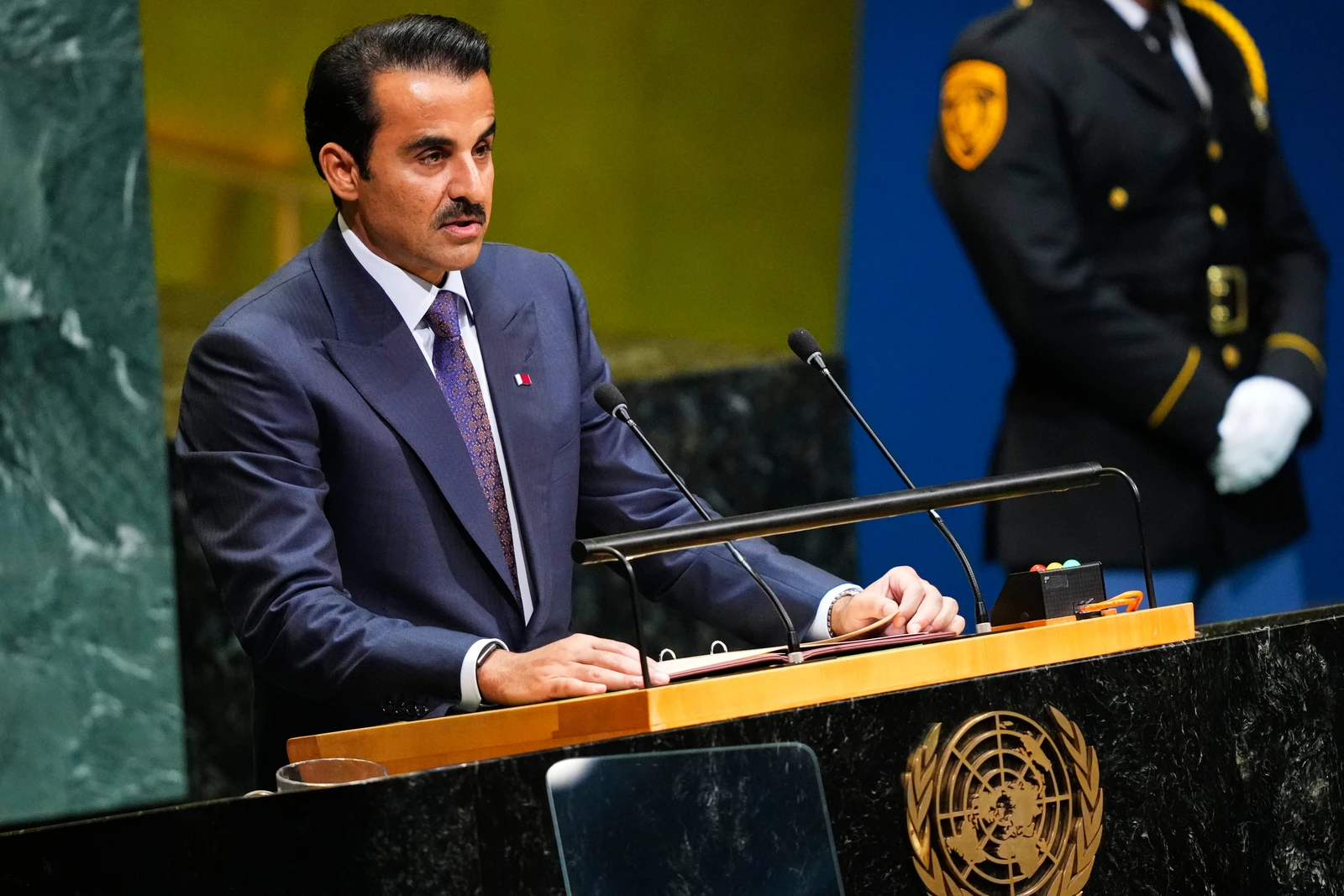
LONDON: The Middle East is going through “one of its most dangerous phases” in its history, Qatar’s emir told the UN General Assembly in New York on Tuesday.
Sheikh Tamim bin Hamad Al-Thani said the situation in the Gulf “should come as no surprise to anyone” and has “repercussions” for the entire world, in reference to the Iran war that has led to attacks on neighboring states and the closure of the Strait of Hormuz.
“It’s the cumulative result of years of postponing crisis management through temporary solutions and unrealistic policies,” he said.
“Our perspective has always been that the way to resolve disputes is through dialogues and negotiations — to reach just, fair solutions grounded in international law, grounded in respect for the sovereignty of states and the rights of peoples. This remains our position in the aftermath.”
The emir called for the establishment of a regional system of “collective security” that “respects the sovereignty, security and territorial integrity of states … that promotes the peaceful settlements of disputes, and the non-interference in the internal affairs of states. In the absence of such a system, it has become possible for a war to erupt.”
He added: “It has become possible for one party to drag its neighbors into a war that isn’t theirs, targeting their vital assets and installations despite their strenuous efforts to avert escalation.
“It has become possible for an international waterway through which nearly a quarter of the world’s energy trade passes to be closed.
“It has also become possible for the lifelines of the global economy to be turned into tools of pressure and bargaining, with people on every continent bearing the cost despite being far removed from the causes of the conflict.
“This is a crisis that drives up the price of food and medicine, and affects the livelihoods of peoples who have nothing to do with any of this.”
Sheikh Tamim continued: “Despite all those developments, which could’ve been avoided, we remain deeply convinced … that the crisis in the Gulf can be resolved through diplomatic means, by reopening the Strait of Hormuz to maritime navigation, and returning to negotiating in order to avert war, paving the way toward a lasting solution that inures sectors and stability for the entire region, including Iran.”
He added: “The opportunity for a peaceful diplomatic solution, which we believe is both possible and realistic, mustn’t be missed.”
Sheikh Tamim also warned that while attention has been drawn by events in the Gulf, the situation in Gaza remains of paramount importance.
“There can be no talk of a just international order as long as Palestine remains a blind spot within it,” he said.
“What has transpired in Gaza is genocide in every sense of the word, and a stain of shame on the conscience of humanity as a whole.
“Future generations will be astonished by the enormous gap between the scale of the catastrophe and the level of the international response to stop it, yet the catastrophe persists, and Israeli leaders have now begun to openly proclaim that the most appropriate solution is to displace the population, which they call migration.”
The emir condemned Israel for its response to the concerns of the international community, saying: “When the extent of global public revulsion at the practises of the Israeli occupation becomes evident, instead of looking in the mirror, they resort to hurling accusations indiscriminately in all directions, at times invoking accusations of antisemitism, and at others resorting to conspiracy theories and accusing other powers and states of being responsible for creating their negative image.
“It’s as though there were no means of communication — as though Israeli soldiers haven’t boasted, through both sound and visuals, of their crimes — and as though images of the crimes against humanity committed in Gaza haven’t been circulated by an entire generation of young people across the world, east and west.”
He called on Israel to be held responsible by the international community for upholding its commitments to peace in their entirety, including “a definitive cessation of operations, withdrawal from the (Gaza) strip, lifting of the blockade, and the unconditional delivery of humanitarian assistance.
“We fear that those who regard displacement as the solution will obstruct anything that could ease the lives of the population.
“The international community bears a direct responsibility to press for implantation, and to ensure that the agreement’s implementation doesn’t remain contingent upon the calculations of a party accustomed to reneging on its commitments whenever circumstances allow it to act with impunity on the ground.
“The continued persecution, apartheid and settler terrorism in the occupied West Bank, and the desecration of Islamic and Christian holy sites — foremost among them the blessed Al-Aqsa Mosque — denying the Palestinian people their rights, most notably their inalienable rights to establish their independent state with East Jerusalem as its capital. All this remains an open wound.”
Sheikh Tamim also discussed Israeli actions in Syria and Lebanon, saying: “Israeli aggression, marked by arrogance and hubris, has expanded to encompass neighboring countries affecting the security of the region as a whole.
“Israel continues its blatant attacks against Syria and is occupying more Syrian territories and adding them to the Golan Heights, which it has occupied since 1967.”
He added: “As though it maintains tutelage over the countries of the region, (Israel) publicly declares that it isn’t bound by its understandings with Lebanon — it insists on continuing its occupation of Lebanese territories and seeks to assume a policing role there.
“Its destruction of entire villages of southern Lebanon, in broad daylight, is reminiscent of its history in Palestine.”
The emir concluded on the issue: “Dealing with Israel — putting an end to the harm it causes and restraining its unlawful conduct — constitutes the true tests of the international community’s seriousness in upholding values and the rule of law.”
He highlighted other regional crises deserving international attention, calling for the removal of armed groups operating beyond state control in a number of countries across the Middle East and North Africa.
Sheikh Tamim said Qatar stands with the people of Syria and Libya as they seek reconstruction and reconciliation.
He called for “an inclusive dialogue” that leads to sustainable peace in Sudan, and reiterated Qatar’s support for the territorial integrity and sovereignty of Somalia, and for a peaceful resolution to the conflict in Yemen.
“Our values aren’t mere slogans we proclaim,” Sheikh Tamim said. “At their core is the conviction that the dignity of the nation can’t be compromised, and that wisdom and firmness are two sides of the same coin.”