

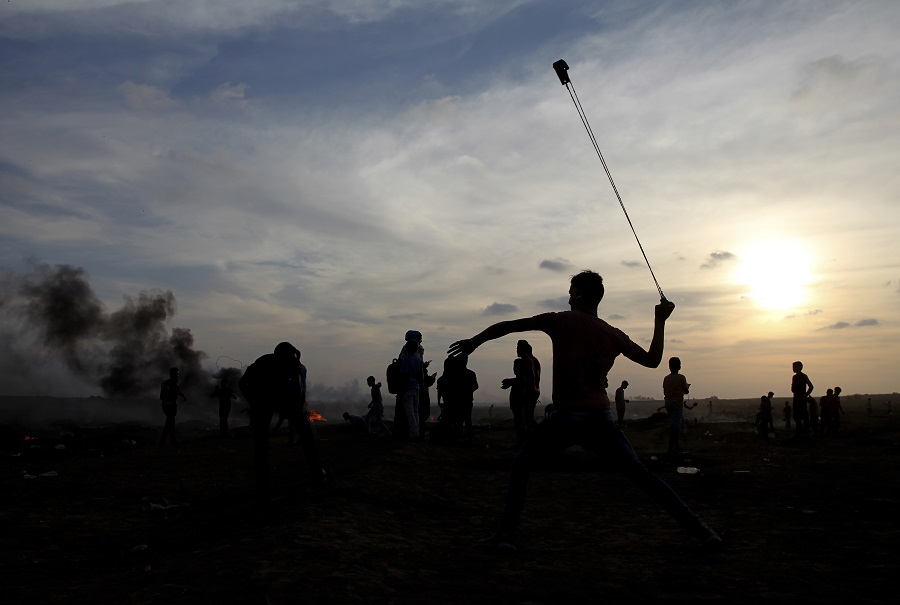
(AFP/Anas Baba)
Bullish Israeli Defense Minister Avigdor Lieberman is no stranger to controversy or name calling, but never before has he been called “weak and leftist,” or been accused of “pulling the entire government to the left.”
The source of this fury was Naftali Bennett, leader of the extreme religious-nationalist Jewish Home Party who also happens to be education minister. He was blaming Lieberman for being too soft on Gaza, and especially Hamas. According to Bennett. those who launch kites and balloons loaded with explosive devices at Israel should be shot dead, even if they are children. For someone like Lieberman, who has built his entire political career on right-wing populism, lives in a settlement in the occupied West Bank and has nurtured a thuggish-like image, Bennett’s description of him must have been startling.
While in opposition, Lieberman promised to liquidate the entire Hamas leadership within 48 hours of coming to power. He might not have changed his mind, but in his ministerial role he has to accept that, demagogy aside, Israel and Hamas are on the verge of another round of bloodshed that neither side has an interest in, or can win.
As defense minister he has the benefit of consulting the heads of the military and other security branches, who are categorically advising against another deadly adventure in the Gaza Strip. Thus far, he and Prime Minister Benjamin Netanyahu have been coordinating to stave off pressure from hawkish elements both inside and outside government to launch a large-scale assault on Hamas in Gaza, including a ground campaign. However, the political pressure to do so is mounting.
What makes the situation explosive, figuratively and literally, is that both the Israeli and Hamas leaderships are under pressure from their own constituencies to act in order to break the current deadlock. They have a choice: They can either decide to alter the situation by reaching a long-term cease-fire that would include easing the blockade on Gaza and consequently improve living conditions there, in return for stopping all aspects of militant activity against Israel. Or they can continue brinkmanship, hurling vitriolic language at each other, persisting with low-intensity violence as the inhuman blockade continues, until at a certain point, as it has done in the past, it escalates into all-out war. It has been more than four years since the last one, and the bloodshed and destruction of 2014 give us a good indication of what to expect should unrestrained violence break out again.
The marches and breaches of the Gaza/Israel fence, and the launch of incendiary devices that have already caused huge damage to Israeli agricultural land, are provoking the Israeli government to react, and typically with excessive force
Yossi Mekelberg
As is customary in this conflict, the need for an agreement does not guarantee that one will be reached. There is zero mutual trust, and both sides feel the need to test each other, which creates conditions that are not conducive to the mediation that Egypt put so much effort into bringing about. More crucially, a long-term and stable cease-fire between Israel and Hamas requires bringing on board the Palestinian Authority and its President Mahmoud Abbas. However, he is reluctant to support such an agreement, which he, with some justification, sees as handing a major victory to his sworn enemy, Hamas.
Moreover, it undermines his longstanding view that peace negotiations, and not the armed struggle, is the way to reach agreements with the Israelis for the benefit of the Palestinians. From his perspective, any gains extracted from Israel by Hamas, following years of armed confrontation, empower those in the West Bank who would like to take a similar route and undermine him.
But this is only one aspect of his opposition to such an agreement. The other has more to do with Washington than Gaza. With good reason, Abbas suspects that this is part of the Trump administration’s grand design for the Palestinians — economic rehabilitation without a political solution at the heart of which is Palestinian self-determination. Abbas is seeing his long, ambitious and tireless work for an independent Palestinian state slipping away.
Yet an agreement is gradually coming to be considered a life saver by Hamas, as well as the Gazan people, so the organization is pushing for one with intensifying militancy. The marches and breaches of the Gaza/Israel fence, and the launch of incendiary devices that have already caused huge damage to Israeli agricultural land, are provoking the Israeli government to react, and typically with excessive force, as happened last week when seven Palestinians, two aged 12 and 14, were killed by Israeli snipers. On the one hand this might just encourage the two sides to return to the negotiation table, but it is more likely to lead to another war.
The heightened hostile rhetoric among Israeli politicians can be also attributed to a general expectation that there will soon be elections. It is happening also at a time when UNWRA is being forced to operate under severe budgetary constraints, thanks to the Trump administration cutting its funds. Anger at the appalling living conditions in Gaza is already being misguidedly directed at the organization that ensures the wellbeing of nearly two-thirds of the population. Without a negotiated agreement between Israel and Hamas which will alleviate the dire conditions that the people of Gaza live in, humanitarian catastrophe and violence are just around the corner. This would benefit only the most extreme elements in Gaza and beyond, compromise the welfare of the Gazan people, and result in more conflict. This is both immoral and self-defeating.
- Yossi Mekelberg is professor of international relations at Regent’s University London, where he is head of the International Relations and Social Sciences Program. He is also an associate fellow of the MENA Program at Chatham House. He is a regular contributor to the international written and electronic media. Twitter: @YMekelberg